
On March 5, 1863, the quiet Tennessee community of Thompson’s Station became the scene of a fierce Civil War battle. Confederate forces under Major General Earl Van Dorn clashed with a Union column commanded by Colonel John Coburn in fighting that swept across the fields, roads, and homes surrounding the small town.
Caught in the middle of it was a 17-year-old girl named Alice Thompson.
What she did that day became one of the most remarkable stories of the Battle of Thompson’s Station.
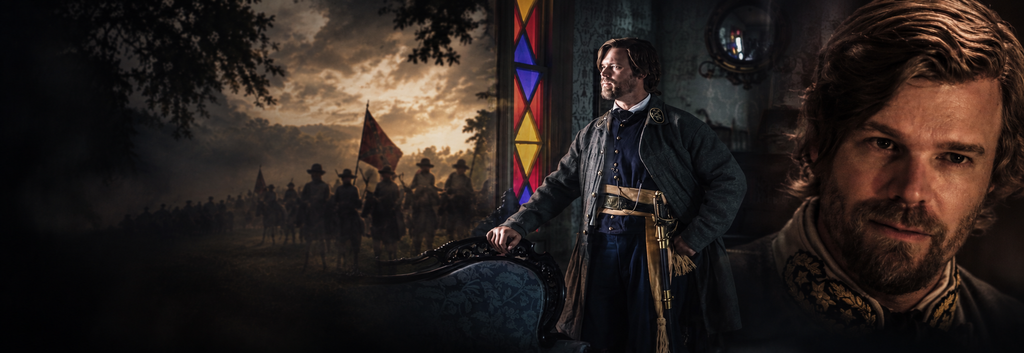
Alice Thompson’s remarkable act of courage is depicted in The Legend of Van Dorn, which dramatizes the Battle of Thompson’s Station and the final months of Confederate cavalry commander Earl Van Dorn’s life. In the film, Alice is portrayed by Lisa Stewart, and her famous dash onto the battlefield is recreated on screen.
A Teenager in the Middle of a Battle
Alice was the daughter of Dr. Elijah Thompson, one of the community’s prominent early residents and the man for whom Thompson’s Station was named.
As fighting erupted on March 5, Alice sought shelter in the half-basement of what was then the Banks family home, today known as Homestead Manor. From the small basement windows, Alice and others watched Confederate soldiers advance and retreat across the property as Union and Confederate forces fought for control of the area.
Among the Confederate troops engaged nearby was the 3rd Arkansas Cavalry, serving in Van Dorn’s command.
During one of the regiment’s attacks, disaster struck.
A devastating Union volley killed Colonel Samuel G. Earle and brought down members of the regiment’s color guard. The Confederate advance faltered as the soldiers lost both their commander and their colors.
Then Alice Thompson ran out of the house.
“Boys, a Woman Has Your Flag!”
Leaving the relative safety of the basement, Alice rushed onto the battlefield and picked up the fallen Confederate flag.
She raised it over her head and began waving it in full view of the fighting.
According to accounts of the battle, a Confederate officer called to the men:
“Boys, a woman has your flag!”
The sight of a 17-year-old girl standing amid the battle with their fallen colors helped rally the Confederate soldiers. They surged forward again.
Alice was standing in an extraordinarily dangerous position. Musket fire was passing across the battlefield, and artillery was in action nearby. One account records that a shell struck the ground only a few feet from her, throwing dirt over her but failing to explode.
She survived unharmed.
Even Union soldiers reportedly admired what they had witnessed. A remembrance published decades later in Confederate Veteran stated simply that “the enemy lauded her action.” Other retellings say Union troops cheered or expressed admiration for her courage.
Whatever their allegiance, the soldiers watching understood the extraordinary bravery required for a teenage girl to leave shelter, enter an active battlefield, and raise a flag whose previous bearer had just been shot down.
The Flag Alice Thompson Carried
The flag Alice raised is sometimes confused in modern retellings with the Bonnie Blue Flag, but historical evidence indicates that it was associated with the 3rd Arkansas Cavalry and the distinctive flag design used by troops under Earl Van Dorn.
Van Dorn’s flag was unlike the Confederate battle flag most people recognize today. It featured a red field decorated with stars and a crescent moon.
That makes Alice Thompson’s story particularly connected to General Earl Van Dorn himself. The young woman who rallied Confederate soldiers at Thompson’s Station was raising the colors of a regiment serving in the army Van Dorn commanded.
Her Courage Did Not End When the Shooting Stopped
Alice’s actions during the battle were only part of her story.
After the fighting, the Banks home became a makeshift hospital for wounded soldiers. Alice helped care for them, reportedly tearing material from her own clothing to make bandages.
Among those associated with the wounded and their care was Dr. David Hamilton Dungan, a Confederate military surgeon and Alice’s sweetheart.
Alice and David later married.
Her life, however, was tragically short. Alice Thompson Dungan died in 1869 at only 23 years old. She was buried near Thompson’s Station, the community bearing her family’s name.
Her act of courage was not forgotten.
Decades after the Civil War, veterans were still telling the story of the teenage girl who ran onto the battlefield and raised their fallen flag. An account published in Confederate Veteran in 1900 argued that her “name and deed should be of foremost record” and compared her with other celebrated Southern heroines of the war.
More than 160 years later, her story continues to be told.
Alice Thompson in The Legend of Van Dorn
Alice Thompson is portrayed as a character in The Legend of Van Dorn, the historical drama centered on Major General Earl Van Dorn and the final period of his extraordinary life.
The Battle of Thompson’s Station plays an important role in Van Dorn’s story. On March 5, 1863, his Confederate cavalry command defeated Coburn’s Union force, with large numbers of Federal soldiers ultimately surrendering.
But within that larger battle was the very personal story of a 17-year-old Tennessee girl who refused to remain a spectator.
Alice Thompson was not a general. She was not a soldier. She had no military rank and no obligation to step onto that battlefield.
Yet when she saw the Confederate colors fall and the soldiers around them falter, she ran toward the fighting.
She picked up the flag.
And she waved it.
It was an act lasting perhaps only moments, but it ensured that the name Alice Thompson would remain part of the history of Thompson’s Station and the American Civil War.
Historical Sources
Accounts of Alice Thompson’s actions appear in multiple historical and modern sources, including Battles and Sketches of the Army of Tennessee by Bromfield L. Ridley, an account published in Confederate Veteran in 1900, the Tennessee Antebellum Trail Guidebook, the Encyclopedia of Arkansas’s history of the 3rd Arkansas Cavalry, and modern histories of the Battle of Thompson’s Station.